
With Women, Our Planet Thrives: Building Rights-Centred, Climate-Resilient Value Chains

Updated: Mar 7
Across India’s rural landscapes, women are central to both ecological stewardship and local economies. They cultivate land, gather forest produce, process raw materials, and sustain craft traditions that have endured for generations. Yet the economic systems surrounding these activities have rarely recognised their contributions with equal access to resources, markets, or decision-making.
Addressing this imbalance requires more than livelihood support—it requires value chains designed around rights, justice, and sustained action. At Industree Foundation, this principle underpins our approach to building nature-based, women-centred rural economies.
Our work demonstrates that when women gain equitable access to resources, knowledge, and markets, the outcomes extend far beyond income generation. Communities become more resilient, local ecosystems are restored, and rural economies become more inclusive and sustainable.
In essence, with women, our planet thrives.
Women at the Centre of Nature-Based Economies
Across forest landscapes and smallholder farms, women are already deeply embedded in the management of natural resources. From gathering non-timber forest produce (NTFP) to cultivating bamboo and other regenerative crops, their work forms the backbone of many rural economies.
However, the value generated by these sectors has historically bypassed the very communities sustaining them. Informal markets, fragmented supply chains, and limited processing capacity often result in low and unstable incomes for women producers.
Industree Foundation works to address this gap by building scalable, inclusive value chains that connect women producers to markets while strengthening ecological systems.
Through a combination of training, collective enterprises, processing infrastructure, and market access, women move from being marginal actors to active participants across the value chain—from cultivation and harvesting to aggregation, processing, and enterprise leadership.
Strengthening Forest Economies through NTFP
India’s forest landscapes support millions of rural households through the collection of non-timber forest produce—ranging from honey and gums to medicinal plants and forest foods. Women are often the primary collectors and processors of these products, carrying extensive knowledge of seasonal cycles and sustainable harvesting practices.
Industree Foundation’s NTFP programmes work to strengthen this traditional knowledge by integrating it with market access, value addition, and collective enterprise models.
By organising women into producer groups and forest-based enterprises, these initiatives enable more stable incomes while ensuring that harvesting practices remain ecologically responsible.
"Women in our communities have always known how to gather forest produce responsibly. When we become part of these collectives, we are able to sell our produce together, negotiate better prices, and ensure that our work is valued more fairly."- Runubala Behera, Stitching Machine Operator, Odisha
"Women hold a great deal of traditional knowledge about forests—when to harvest, what to collect, and how to protect the ecosystem. Our work builds on this knowledge while helping them access better markets and income opportunities."- Swarna Bhoi, Quality Checker, Odisha
"Through training and value addition, we are now able to process forest produce instead of selling it as raw material. This simple shift has helped many households earn more while benefiting the community."- Charulata Parbat, Machine Operator, Odisha
In strengthening forest economies, the emphasis is not only on increasing incomes but on building systems where local communities remain stewards of biodiversity while benefiting economically from sustainable resource use.
Bamboo and Climate-Resilient Rural Livelihoods
Bamboo has emerged as a powerful catalyst for both ecological restoration and rural enterprise development. As one of the fastest-growing plants in the world, bamboo restores degraded land, improves soil health, and provides a renewable raw material for a wide range of products.
Industree Foundation’s bamboo programmes support smallholder farmers—particularly women—to cultivate bamboo through demand-led, climate-sensitive plantation models. By linking cultivation with processing and market demand, these models create sustainable income streams while strengthening climate resilience.
Women farmers and entrepreneurs play a critical role in this ecosystem—participating not only in plantation activities but also in processing, craft production, and enterprise leadership.
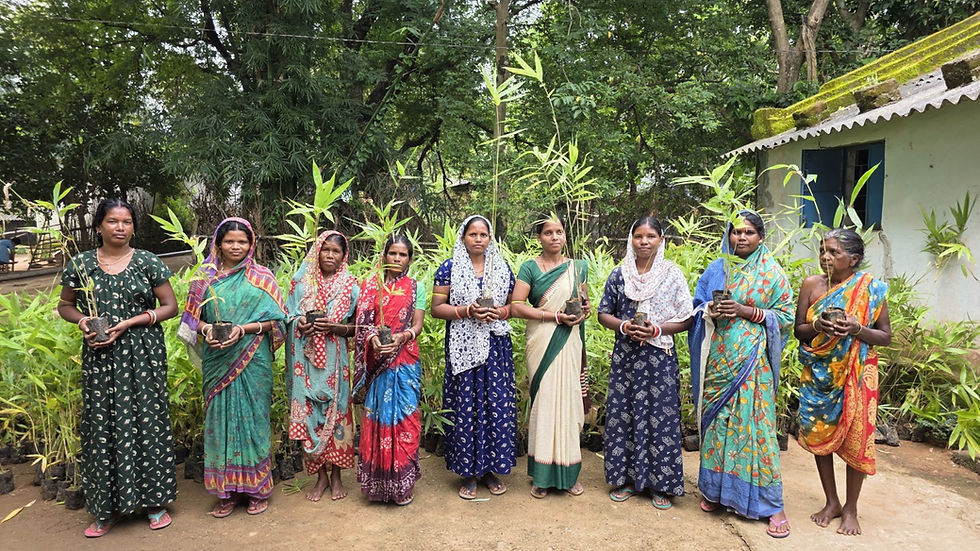
“In many rural communities, women have a deep understanding of the land and its resources. When women take up bamboo cultivation, it not only helps restore degraded landscapes but also creates long-term livelihood opportunities for their families.”- Nang Chetjawa Mannow, District Coordinator, Arunachal Pradesh
“In our producer groups, women are involved in every step of the bamboo enterprise—from processing the raw material to creating finished products. As we learned these skills, our confidence began to grow. The training not only strengthened our work but also encouraged many of us to step forward and take leadership roles within the enterprise.”- Savitha Krishna, Producer, Karnataka
"Just like the roots of bamboo strengthen the soil, the strength of women moves society forward. With hard work, patience, and courage, they build new horizons of development.”- Jewel Debnath, District Coordinator, Thripura
"Give women land, bamboo, and opportunity—watch them restore ecosystems, build economies, and transform generations."- Siddhi Shivram Pednekar, Technical Executive, Odisha
These efforts demonstrate how regenerative agriculture and enterprise development can move together, creating economic opportunity while restoring ecological balance.
Scaling Inclusive Value Chains
A central insight from Industree Foundation’s work is that sustainable rural development requires systems thinking. Isolated interventions rarely create lasting change. Instead, the focus must be on building interconnected ecosystems where production, enterprise development, and markets reinforce each other.
This is why our programmes prioritise inclusive value chain development—ensuring that women producers are integrated into each stage of the economic system rather than remaining confined to the lowest-value segments.
From forest produce to bamboo-based livelihoods, the approach centres on:
Strengthening community institutions and producer collectives
Supporting women-led enterprises
Creating market linkages and demand-driven production systems
Promoting regenerative and climate-resilient resource management
These models are designed not only to generate livelihoods today but to create scalable pathways for rural prosperity that are both environmentally sustainable and socially inclusive.
Towards Regenerative Rural Economies
Across forests, farms, and rural enterprises, the women working within these value chains are shaping new economic possibilities. Their work reflects a powerful intersection between livelihood security, ecological stewardship, and community leadership.
As these models continue to grow, they point toward a broader transformation in how rural economies can be structured—one where natural resources are managed sustainably, value chains are inclusive, and women hold central roles in shaping the future of their communities.
Because when economic systems recognise women’s leadership and agency, the results extend well beyond individual livelihoods.
Communities flourish. Ecosystems regenerate. And our planet thrives.


Comments